
On Opening Convocation Day, Sept. 10, Morehouse President F. DuBois Bowman ’92, Ph.D., issued a charge to the College, setting the agenda for his administration and focusing attention on strategies that produce principled leaders who are steadfast, honest, and true to their values—and well prepared, both academically and experientially, for the road ahead.
 “We have the distinction of serving as the nation’s premier producer of Black male talent prepared to lead across business, science, technology, the arts, education, government, and countless other fields,” Bowman said at the ceremony launching the Fall Semester. “The work and preparation start now.”
At the Morehouse Real Estate Institute (MREI)—where the next generation of aspiring commercial real estate professionals are trained how to pitch multi-million-dollar development deals, manage property portfolios, finance new construction, lead complex companies, and create generational wealth—building next-level leaders is the mission. The Institute is the nation’s first endowed real estate program at an HBCU.
The Institute was first developed in the 1980s by the Morehouse Division of Business and Economics, under the leadership of the late Alan Pinado Sr., a benefactor and professor whose gift from New York Life helped to fund its first classes. It was relaunched three years ago to foster entrepreneurship and to maximize rising Morehouse Men and Atlanta University students’ potential for growth and financial prosperity in the nearly $49 trillion U.S. housing market and the $26 trillion commercial real estate market.
The program gives students a seat at the table where real estate deals are made. It aims to improve diversity in real estate management, where racial representation for people of color has lagged for decades.
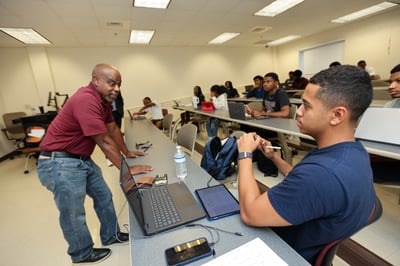
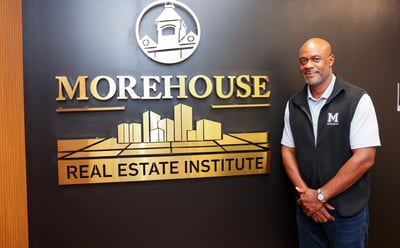 “Forty percent of our programming is experiential learning. We have students working on live projects around the country where they get to tour the property, listen to the developer, listen to the community, listen to city hall, and then do the research to come up with the highest and best use for a property, whether it's land, a building, or a mixed-use development,” said James Tarpeh ’92, an adjunct professor and the Institute’s executive director, who has more than two decades of experience in finance and commercial real estate. “We just did one in South Fulton. The seller had 100 acres of land with beautiful rolling hills and a lake. The students came up with four different renderings and did the math to show the cost, the benefit, the internal rate of return—everything that tells the story so that the developer and investor know that the deal makes sense.”
Investment is essential to Morehouse Real Estate Institute’s future growth and its primary goal of someday elevating real estate studies to a minor at Morehouse.
In fact, Tarpeh is partnering with Morehouse Trustee John O’Neill on an ambitious campaign to raise $30 million by 2028. The effort was launched following a $3 million leadership gift from Prologis, a global leader in logistics real estate, in 2023 to help Morehouse create a pipeline for diverse talent in real estate, and a $1.5 million contribution a year later from Dominium, a national leader in affordable housing development, ownership, and management.
The movement continues to gain ground and has attracted some influential foot soldiers, including representatives from Amazon, H.J. Russell & Company, a Black-owned construction firm, and JLL, which provides global market analytics and operations services in real estate and logistics. The firms are among the 30 represented on the Institute's advisory board.
Making an Impact with Investment
 As fundraising continues, MREI is recruiting raw talent to fill its classes and offering students life-changing opportunities and experiences. Students such as Jibri Wright, 21, of St. Petersburg, Florida, who sat proudly with the Class of 2027 on Convocation Day, have found their calling in commercial real estate. He almost didn’t go to college—it wasn’t in his family’s budget.
“It was Morehouse or the Marines,” Wright said. But instead of enlisting, he was offered a lifeline—an institutional scholarship from Morehouse and, later, an introduction into commercial real estate.
Now, he’s using AI to build a disaster response plan app for warehouses owned by Prologis, a global leader in logistics real estate.
Prologis has a portfolio of more than 1.2 billion square feet of warehouses and distribution and fulfillment centers in 19 countries. In addition to its gift to Morehouse, the real estate giant also committed to providing competitive internships for exceptional students.
Wright is among the chosen few. “Out of 14,000 applications, Prologis chooses fewer than 20 interns—and I am one of them,” said Wright, Morehouse’s first-semester intern with Prologis. “I’m still feeling the impact of that. I come from a single-family household where wealth is not attainable. A lot of my family don’t work in corporate spaces.”
Relationships in the Industry Foster Career Opportunities for Students
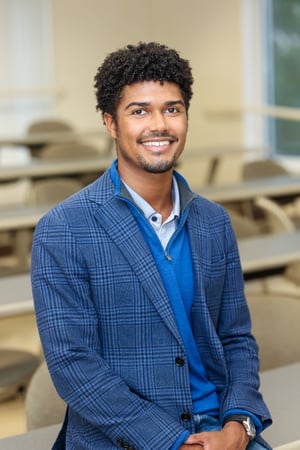 Eric Anders, a senior finance major from Washington, D.C., received a job offer with Partners Real Estate, where Trustee O’Neill serves as President and Managing Partner, Southeast.
Anders came to Morehouse searching for his passion, first exploring academic interests in history and international relations before moving on to internships in high finance.
In his senior year, Anders discovered a newfound fascination with commercial real estate—which sits at the intersection of finance, business, community development, and public policy. The industry helps to shape neighborhoods, create jobs, influence housing access, and drive economic growth.
“I had been asking myself, ‘What does my dream job look like?’” Anders said. “I wanted to be in a place where I could be learning how to actively research and invest in opportunities where my investment is the driver for a community's direct economic growth, including business growth. A career in commercial real estate development would allow me to use my gifts and goals to invest and make a lasting impact on our community, country, and global network."
“I took Professor Tarpeh’s investment finance class, and we really got into the weeds of how to make sound investment decisions and operationally execute those decisions."
Tarpeh made a call to O’Neill and helped Anders get a development analyst internship, which will turn into a full-time job after graduation. “I have great face time with John O’Neill. He’s taken an interest in involving me in the Partners programming,” Anders said. ““I value being in an ambitious environment and knowing my work product warrants trusting me with responsibility."
Building a Pipeline of Real Estate Leaders that Defy Disparities
Tarpeh was hired as the Institute’s executive director in November 2025 following the transformative gift from Dominium to help expand teaching and learning in the Institute and increase opportunities for job placement success.
Across the country, Black professionals remain significantly underrepresented in commercial real estate leadership. Today, for example, Black professionals hold fewer than 2% of senior executive roles in the industry. According to the U.S. Bureau of Labor Statistics, only 10% of real estate professionals are Black, and 82% are White. For real estate brokers, who are typically higher-paid and have other agents working under them, the gap widens to 5% for Black brokers. In commercial real estate management, less than 2% of C-level positions are held by Black males, and a percentage of executives in the industry are White.
Tarpeh is on a mission to improve those odds. He is now traveling the country seeking fresh opportunities for his students and investment in the Institute, equipped with a wealth of expertise in banking, market forecasting, and data analytics from his years in finance, an extensive background in commercial real estate management and logistics honed during his years as a commercial banker with J.P. Morgan, a senior operations manager at Amazon, and a portfolio of land acquisition and multi-million-dollar development deals he closed as director of real estate for Waffle House in Atlanta.
“We have to have the resources, so we are not chasing fundraising every year and can focus on programming and developing our students,” said Tarpeh, who has an MBA from Southern Methodist University. “I want recruiters to come to the Morehouse College Real Estate Institute because we have the best of the best.”
Tarpeh is strategically asking industry leaders across the country what gold-standard credentials Morehouse graduates need to acquire to outpace the competition, and Tarpeh intends to deliver. He’s overhauling the Institute’s curriculum to produce the ideal candidate. The Institute’s original faculty, Oscar Sistrunk ’78, Brian King ’80, and Richard Slaton ’95, also offer Tarpeh advice on expanding the program. It now includes auxiliary groups, such as the Morehouse Real Estate Society, an interest group of 90 students from the Atlanta University Center seeking careers in the field.
Developing a New Foundation for Academic Knowledge and Skills
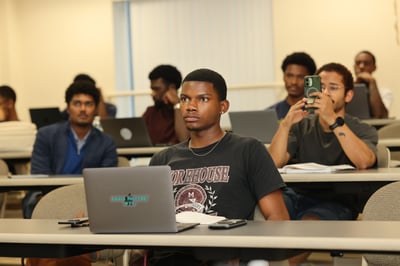 Under Tarpeh’s leadership, the Institute’s offerings have more than doubled. Now, not only does the Institute have three core classes—real estate finance, appraisal and valuation, and introduction to commercial real estate and special topics—it has a new finance academy for specialized studies in financial modeling, real estate development, AI in commercial real estate, and real estate capital markets supported by a generous $200,000 gift from Morehouse College alumnus Truman N. Tolefree ’02 and co-founder and managing principal of his firm, Intersection Realty Group, which established the new Truman Tolefree and Intersection Realty Group Commercial Real Estate Finance Academy.
The Academy provides Morehouse students with a solid foundation in the technical and analytical aspects of commercial real estate finance, investment, development, and asset management. It also aims to ensure that the future of urban corridors is shaped by those who understand the power of ethical revitalization and community wealth creation.
Of the more than 112,000 private commercial real estate firms in the United States, fewer than 450 are majority Black-owned. Intersection Realty Group and Truman Tolefree, a 23-year industry veteran, are part of a small group helping change that reality.
“Historically, many communities of color have participated more as consumers of real estate rather than as owners, developers, investors, or capital allocators,” he said. “We want talented young people, particularly people of color, to see themselves not only working in the industry, but also leading firms and having the confidence to believe that they belong in rooms where major investment and development decisions are being made.”
Building Innovation Through Partnerships
The Institute has a cutting-edge, industry-endorsed curriculum in collaboration with Project Destined, a national network training rising real estate leaders in more than 2,000 universities, including the University of Pennsylvania and Cornell University. Project Destined provides participating schools with access to a prestigious network of professors and experts in the field, career placement support, scholarships, and live real estate deals pending with national firms. Next, the Institute hopes to add another signature program—Wall Street Prep—making it the first undergraduate institution to offer the practical finance and accounting program.
Senior Jibri Wright is looking forward to graduating in May 2027. He’s ready to work full-time in real estate. He also has a resume full of experience, having completed a load of industry classes at the Institute and Project Destined, as well as on-the-job training with a neighborhood community development association, prepping vacant lots for new construction. Now, at Prologis, Wright hopes to leave a lasting impression and possibly land a job offer that will keep the firm recruiting rising Morehouse Men for their leadership, integrity, ambition, ingenuity, and career-ready skills.
“I want to get in the door and leave it open for those behind me,” Wright said.