
Black cinema has never been just content. From early race films to today’s streaming platforms, Black filmmakers have used the screen as resistance, memory, and cultural intervention.
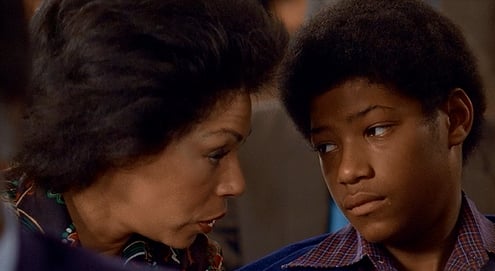
Rosalind Cash in “Cornbread, Earl and Me” (1975). (AP photo)
Even when marketed as entertainment, representation carries weight. Cultural scholar and filmmaker Stephane Dunn says the debate is not simply about whether a film intends to be political. It is about what representation does.
“The films are often too political without intending to be,” Dunn said. Audiences and critics, she noted, “tease out the politics” even while “consumers [are] just sitting there enjoying the ride.”
That tension stretches back nearly a century. In 1926, W.E.B. Du Bois wrote in “Criteria of Negro Art” that Black art is inherently political and functions as propaganda in the fight for equality.That same year, Langston Hughes argued in “The Negro Artist and the Racial Mountain” that Black artists should embrace their culture without apology. Those ideas continue to shape conversations about Black film.
Are Black films responsible for uplift and moral instruction? Or are they free to be complicated, flawed, joyful, and human? Dunn believes the answer lies less in stated intent and more in authorship and framing. “Going there to represent us is a political act,” she said.
Long before Hollywood opened its doors, Black filmmakers were building their own. Oscar Micheaux’s 1920 film “Within Our Gates” directly challenged racist cinematic narratives and offered counter-images of Black life.
The struggle over dignity on screen began early. It has never ended. By the late 1960s, a new wave of Black filmmakers emerged. Gordon Parks directed “The Learning Tree” in 1969, marking a major studio breakthrough for a Black director.
Then came the 1970s, a decade Dunn describes as extraordinarily rich.
Films such as “Shaft,” “Super Fly,” “Coffy,” and “Foxy Brown” did more than entertain. They influenced music, fashion, language, and swagger.
“These films spawned hit soundtracks,” Dunn said. “They moved beyond the screen and into everyday culture.”
But the decade was not one note. It also included “Sounder,” “Cornbread, Earl and Me,” “Cooley High,” and Charles Burnett’s “Killer of Sheep.”
“There was such diversity in that decade,” Dunn said. “It was an extraordinarily rich period.”
For Dunn, overt messaging is not the only measure of political impact. Simply centering Black life can be transformative.
“The topics may not be overtly political,” she said, “but going there to represent us is a political act.”
The debates did not stop in the 1970s. The 1990s raised new questions about realism and representation, while 21st-century films such as “Selma,” “Moonlight,” “Get Out,” and “Black Panther” reopened conversations about power, authorship, and visibility.
Read the full article here.