
Working in teams, students developed AI-powered concepts and prototypes to address real-world challenges in education, healthcare, sustainability, accessibility, and economic opportunity, culminating in final-day pitches from 11 teams that highlighted student-led, interdisciplinary innovation.
After an eventful week marking its 159th anniversary, highlighted by the inauguration of its 13th president, Dr. F. DuBois Bowman ’92, Morehouse College concluded the celebration by hosting its first inaugural President’s Hackathon. The three-day innovation experience drew interest from more than 120 students, with 45 participants representing 31 majors collaborating across disciplines in an immersive challenge centered on generative artificial intelligence and entrepreneurial design thinking.
Organized in partnership with ACT House and supported by the Atlanta technology community, the President’s Hackathon was created to develop leaders equipped to leverage emerging technologies for equity and global impact. During the 36-hour event, students participated in intensive problem-solving, mentorship, and iterative design, culminating in final presentations that showcased technical innovation and social responsibility. Teams competed for up to $10,000 in cash prizes, as well as startup incubation and industry mentorship to further develop their projects.
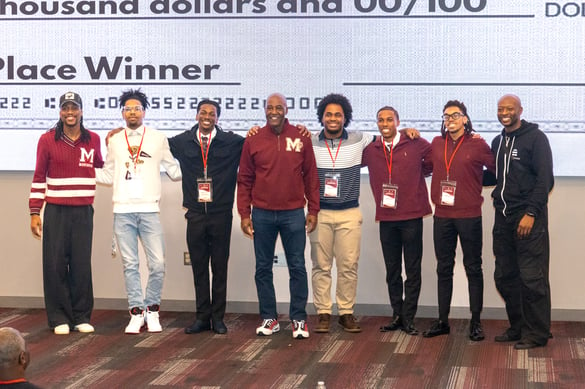 First-place team, GD Academy pictured with President F. DuBois Bowman '92
The first-place team, GD Academy, impressed judges with a bold vision for broadening access to game development education. Designed as a mobile-first learning platform, GD Academy addresses a significant barrier for aspiring creators in underserved communities: the reliance on costly PC hardware. By enabling students to learn directly on their smartphones, the platform increases opportunities for young artists and programmers who may otherwise lack access to the gaming industry.
GD Academy provides structured learning pathways for both creative and technical disciplines, supported by an AI mentor that assists students in overcoming challenges and addressing learning gaps in real time. One of the platform’s strongest advantages is its ability to help users build shareable portfolios while acquiring professional coding skills entirely on mobile devices. Targeting underserved teens and young adults aged 14 to 24, GD Academy employs a tiered subscription model, offering a free Lite version as well as Creator+ and Pro plans with advanced features. The team consists of Amari Coleman ’28, Elijah Flores ’27, KeiShaun Mortis ’27, Kyree Lovelace ’28, and Michael Moore ’27.
The second-place team, MediScribe, addressed the widespread challenge faced by clinicians of extended hours spent on patient documentation after work, commonly known as “pajama time.” MediScribe is an AI-powered clinical documentation tool that utilizes ambient capture to record patient-provider interactions and automatically generate structured SOAP notes and personalized treatment recommendations.
MediScribe distinguishes itself through a transparent “glass box” system that links each AI-generated entry directly to supporting evidence in the patient’s medical record. The platform is intended for both independent practitioners and large healthcare organizations, including institutions such as Emory Healthcare. MediScribe follows a SaaS pricing model, with plans ranging from $129 per month for solo practitioners to $725 per seat for enterprise clients. The team comprises Chace Cleveland ’27, Theodore Hervey ’29, Jonari Chevalier ’29, Nii Nai Odamtten Sowah ’26, and Amir Faulkner ’27.
The third-place team, CarePath, developed an AI-powered care coordination platform aimed at enhancing the delivery of mental health and developmental support in public school systems. CarePath addresses the fragmented and complex landscape of student support services by providing counselors with automated guidance and matching students to appropriate government programs and evidence-based resources.
A key feature of CarePath is its capacity to convert complex Individualized Education Programs (IEPs) and medical documentation into accessible summaries for parents, thereby improving communication between schools and families. The platform currently targets public school districts in the Metro Atlanta area, with a projected serviceable obtainable market of $14.1 million. CarePath employs a district-based pricing model, charging schools $25 per enrolled student. The team consists of Ahmed Kiel-Kamil ’26, Aren Egwueke ’26, Supreme Constantine ’26, and Isaiah Johnson ’26.
The competition was structured around three thematic areas: personal good and empowerment, entrepreneurship and workforce innovation, and societal impact and equity. Within these themes, students proposed solutions to improve learning, wellness, and personal agency; support small businesses and workforce development through AI-based tools; and advance fairness, access, sustainability, and wealth creation in communities and systems.
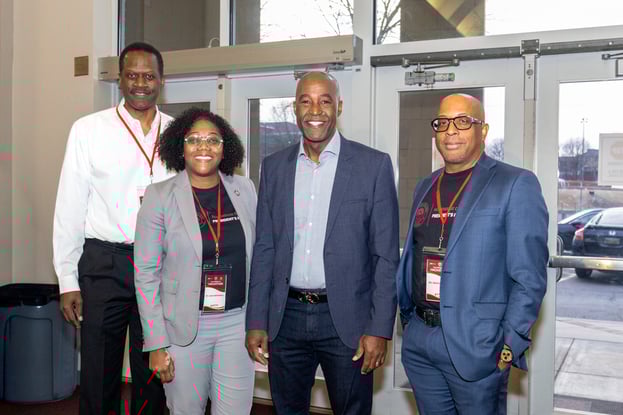 From Left to Right: Dr. Alfred Watkins, Dr. Juana Mendenhall, President F. DuBois Bowman '92, Dr. Grant Warner
The event was directed by campus and consortium leaders recognized for their work in innovation and entrepreneurship, including Dr. Juana Mendenhall, Vice Provost for Academic Innovation and Learning; Dr. Grant Warner, Executive Director of the Center for Black Entrepreneurship; and Dr. Alfred Watkins, Interim Director of the AUC Data Science Institute. Their leadership, together with support from faculty, entrepreneurs, and industry mentors, fostered an environment that encouraged students to consider the broader role of artificial intelligence in promoting the public good.